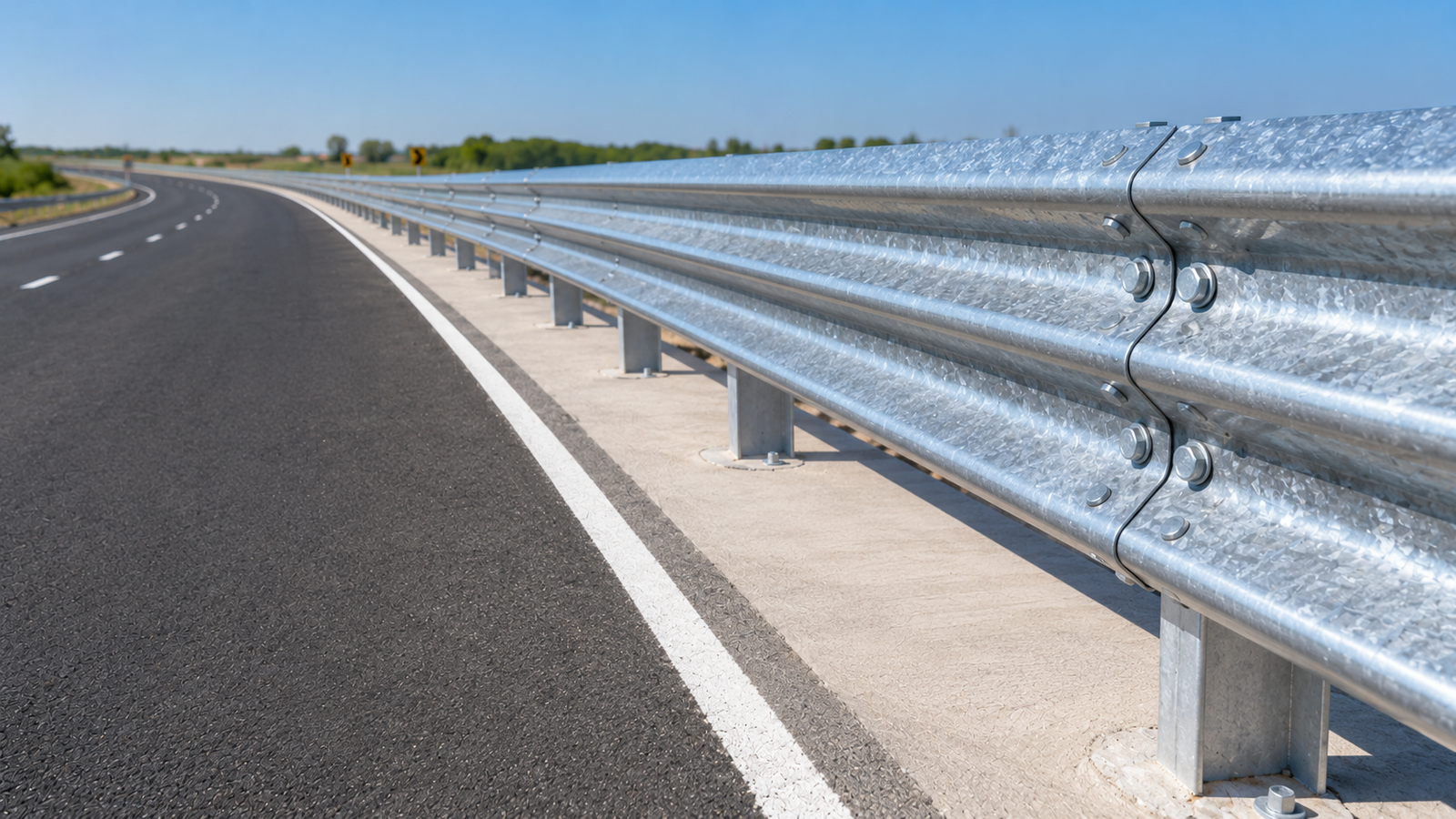
Road markings are the most fundamental visual guidance system on national highways, state corridors, and urban expressways. While physical barriers contain vehicles once a crash begins, road markings, edge lines, and lane dividers provide continuous optical navigation that prevents run-off-road collisions and head-on crossover accidents in the first place.
Under Indian conditions — characterized by heavy monsoon downpours, high daytime surface asphalt temperatures exceeding 60°C, and abrasive multi-axle freight traffic — conventional cold-applied solvent paints degrade rapidly within months. Consequently, MoRTH Specifications for Road and Bridge Works (Section 800, Clause 803) and Indian Roads Congress code IRC:35:2015 (Code of Practice for Road Markings) make hot-applied thermoplastic road marking material mandatory across all major highway concessions. Below is a comprehensive procurement and quality control guide from Auroguard Private Limited for specifying thermoplastic materials and retroreflective optics.
1. Chemical Composition & Physical Criteria Under MoRTH Clause 803
Thermoplastic marking material is a 100% solid, solvent-free formulation consisting of synthetic hydrocarbon or alkyd resins, titanium dioxide (white) or heat-stable organic/inorganic pigments (yellow), mineral extenders, and pre-mixed reflectorizing glass beads.
To ensure long-term durability on both bituminous asphalt and concrete pavements, Clause 803 enforces strict material thresholds:
- Binder Content: Minimum 18.0% by weight. Synthetic hydrocarbon or alkyd resins ensure elastic adhesion under high asphalt deflection without thermal softening in summer or brittle cracking in winter.
- Titanium Dioxide (TiO2) Content: Minimum 10.0% by weight for white thermoplastic marking to guarantee high luminance factor (Daylight 45°/0° luminous reflectance ≥70%) and resistance to UV yellowing.
- Pre-Mixed Glass Beads (Intermix): Minimum 20.0% to 30.0% by weight of Type 1 glass beads thoroughly compounded into the formulation. As traffic wears down the surface thermoplastic layer, these embedded beads are continuously exposed, sustaining nighttime retroreflection throughout the line's service life.
- Softening Point (Ring and Ball Method): 102.5°C ± 9.5°C as per IS 15388 / BS 3262, preventing tyre imprint indentation under standing heavy commercial vehicles at high ambient pavement temperatures.
2. The Science of Nighttime Retroreflection: Type 1 vs. Type 2 Glass Beads
Road markings only reflect light back to a driver's eyes at night when spherical, high-refractive-index glass beads act as micro-retroreflective lenses. Under IRC:35:2015 and BS 6088 / EN 1424, a compliant road marking system combines two distinct bead applications:
| Glass Bead Category | Method of Application & Dosage | Bead Sizing & Function | Required Performance Standard |
|---|---|---|---|
| Type 1 (Intermix Beads) | Mixed directly into the dry thermoplastic bag during manufacturing (min. 20–30% by weight) | Gradation: 150 to 850 microns; provides long-term retention of retroreflectivity as surface wears down | BS 6088 Class A / IS 3457 |
| Type 2 (Drop-On / Surface Beads) | Sprayed pneumatically onto molten thermoplastic at 180°C–200°C at min. 250–350 g/m² | Gradation: 250 to 850 microns (min. 70–80% roundness); embeds at 50–60% depth to provide immediate Day-1 retroreflectivity | BS 6088 Class B / EN 1424 |
| Minimum Initial Retroreflectivity (RL) | Measured using a 30-metre geometry retroreflectometer within 14 days of application | White Lines: ≥ 200 mcd/m²/lux Yellow Lines: ≥ 150 mcd/m²/lux |
IRC:35:2015 Clause 11, Table 11.1 |
| Skid Resistance Value (SRV) | Measured using the British Pendulum Tester on wet marking | Minimum 45 BPN (British Pendulum Number) to ensure braking traction for two-wheelers and passenger vehicles | MoRTH Clause 803.4.4 |
3. Best-Practice Site Application & Surface Preparation
Even the highest quality thermoplastic formulation will blister, delaminate, or lose retroreflectivity if installation parameters are violated on site:
- Pavement Primer on Cement Concrete (Rigid Pavement): Thermoplastic bonds through thermal mechanical fusing into asphalt bitumen. On Portland cement concrete pavements or aged, oxidized bitumen, applying an epoxy- or solvent-based primer before screeding is mandatory under MoRTH Clause 803 to prevent flaking.
- Application Temperature Window: Maintain molten material between 190°C and 210°C in the pre-heater boiler. Overheating chars the resin (causing discoloration), while under-heating prevents bead sinking, causing drop-on beads to scatter under tyre traffic.
- Thickness Control: Standard road markings require 2.5 mm screed thickness. Transverse rumble strips or high-wear stop bars require 5.0 mm profiled application.
- Integration with Solar Raised Pavement Markers (Cat's Eyes): In heavy fog zones, curves, and unlit corridors, pair edge markings with 360° retroreflective or solar LED road studs (IRC:35:2015) spaced at 9.0 m to 18.0 m intervals to give long-range optical warnings during rain.
4. Frequently Asked Questions (FAQ)
What is the standard screed thickness for highway thermoplastic markings under MoRTH?
MoRTH Clause 803 mandates an application thickness of 2.5 mm (excluding surface drop-on glass beads) for longitudinal lane lines and edge markings, and up to 5.0 mm for pedestrian crossings and transverse rumble strips.
Why do newly applied road markings sometimes fail night retroreflection tests?
Failure usually stems from inadequate drop-on bead dosage (below 250 g/m²), incorrect bead embedding depth (beads must sink 50% to 60% into molten paint for optimum focal refraction; sinking too deep drowns the optical lens, while sitting too high causes tyres to shear them off immediately), or using beads with low sphericity (<70% roundness).
How does IRC:35:2015 define the maintenance threshold for road marking replacement?
Under IRC:35:2015 maintenance guidelines, National Highway markings must be re-applied or refreshed whenever retroreflectivity drops below 100 mcd/m²/lux for white lines or 80 mcd/m²/lux for yellow lines, or when more than 20% of the surface area is worn away.
Source High-Performance Road Safety Furniture from Auroguard
Looking for certified thermoplastic road marking materials, drop-on glass beads, solar road studs, delineators, or MoRTH-compliant highway crash barriers? Auroguard Private Limited manufactures and distributes a complete 6-category portfolio of road safety, geosynthetics, and lighting infrastructure from Kolkata with direct dispatch across India. Send your project BOQ and material specifications to hitesh@auroguard.co.in or sales@auroguard.co.in, or call/WhatsApp +91 90510 39176 for factory-direct pricing.